LLM Wikis & Shiny Ideas
all that glitters is not gold
You’ve seen this picture. A galaxy of glowing nodes, lines stretched between them like neural tissue, a satisfying jiggle when you grab one and drag. The Obsidian graph view is the single most-screenshotted artifact in personal knowledge management, but nobody can really tell you what all these connections tangibly help with.
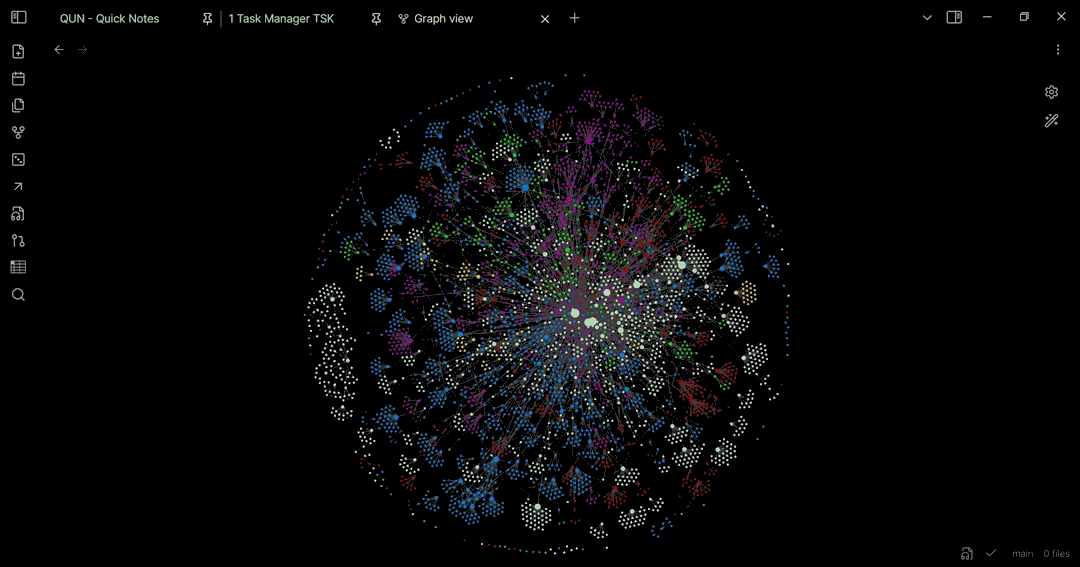
Some ideas have an aesthetic that registers as future so strongly it stops being a question whether they are useful. The graph view is one of them. The LLM wiki is the same trick at higher resolution, and it’s broken in the same way.
In April, Karpathy posted a gist describing a pattern. Drop your articles and papers into a folder, point an LLM agent at it, and let the agent build a living wiki — entity pages, summaries, cross-references, contradictions flagged, the whole thing self-maintaining as you add sources. Famously:
Obsidian is the IDE; the LLM is the programmer; the wiki is the codebase.
The pitch is that the bookkeeping burden finally goes away. LLMs don’t get bored so maintenance cost goes to zero. The vault stays alive.
A dozen breathless follow-up posts later, the trend is the trend. And it’s easy to see why: the pattern solves a real, named pain. It runs on tools that already feel sophisticated. It produces an artifact you can show people. Every ingest run rewards you with new pages, new links, new nodes in the graph. The dopamine is real. A research-assistant chatbot on top is just the cherry.
But the bookkeeping was never the problem.
Knowledge cannot be offloaded (at least for now :D). If a coworker says something at lunch that should connect to one of those notes, the LLM isn’t in the room. The connection has to happen live, in your head, drawing on knowledge you’ve actually internalized. The wiki compounds files. Whether anything compounds in you is a separate question, and the wiki neither answers it nor helps. A queryable filing cabinet is not knowledge no matter how dense the graph view gets, it remains files on a disk. The connections are great for a third party to go over your notes, but for you it’s not that much help really.
Karpathy’s gist reserves the thinking part for the human “ask good questions, think about what it all means.” That’s the theoretical division of labor. In practice nobody does the half they’re assigned. Vibe coding ships code people can’t explain. The LLM wiki ships understanding people never had. The agent reads. You don’t. Only one of you walks into the meeting…
This is what the graph view was the warning for. It looked like the topology of a mind. It was the topology of files. The relationship between the two was always assumed, never demonstrated, and the screenshot was so satisfying nobody pressed on the assumption. The LLM wiki does the same substitution at a higher fidelity with its synthesis-shaped files, contradiction-shaped flags, understanding-shaped artifacts. The visual sophistication exceeds the cognitive work that produced it. That’s the shiny-idea move in its purest form: something that looks like it can help, well enough that you stop checking whether it actually does.
Don’t get me wrong, I still use org-roam for my notes and find utility in being able to reference other notes easily. However, I’ve learned to reduce my workflow to only the connections and tools that I find helpful in practice (as opposed to those that are only helpful in theory).
The graph view is gorgeous. So is a wiki that maintains itself. Neither one is in your head.